Lucerne in Two Days: City Highlights Plus One Mountain Day
Here’s the thing most guides skip: the mountain trip that fills half of them doesn’t run all year. Pilatus’s full “Golden Round Trip” — the boat-plus-cogwheel loop everyone photographs — operates only from 11 May to 18 October in 2026 (Last verified: July 2026, Pilatus-Bahnen). Rigi, its quieter rival across the lake, runs every day of the year. So the first real decision in any Lucerne 2 day itinerary isn’t what to see. It’s which mountain fits your dates.
Short answer: spend day one in Lucerne’s Old Town — Chapel Bridge, the Musegg Wall, the Lion Monument and the Reuss riverfront — and save day two for a mountain, Pilatus or Rigi. If clouds move in, flip the days. The city works in any weather; the summits don’t.
That’s the whole plan in two sentences. What follows fills in the order that actually works on foot, a side-by-side on the two mountains with real 2026 operating dates, the rule for deciding which day goes where, and the pass math for a stay this short. Two days is enough for the highlights and one summit. It isn’t enough to improvise, which is why the sequencing matters more than the sightseeing list.
If your schedule allows only one day, use this one-day Lucerne itinerary to choose between Old Town, a lake cruise and one mountain without forcing all three.
Day One of Your Lucerne 2 Day Itinerary: Old Town on Foot
Almost everything on day one sits within about a fifteen-minute walk. This is a day you do on foot, not on transport, and that alone saves you an hour of fumbling with tickets.
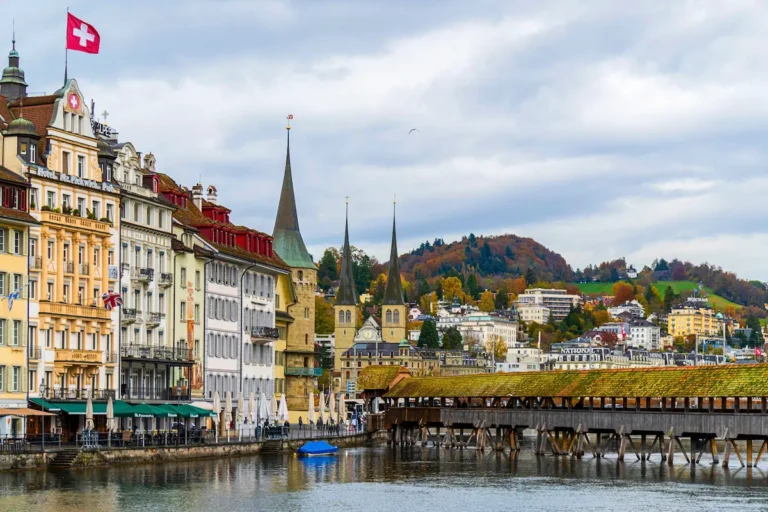
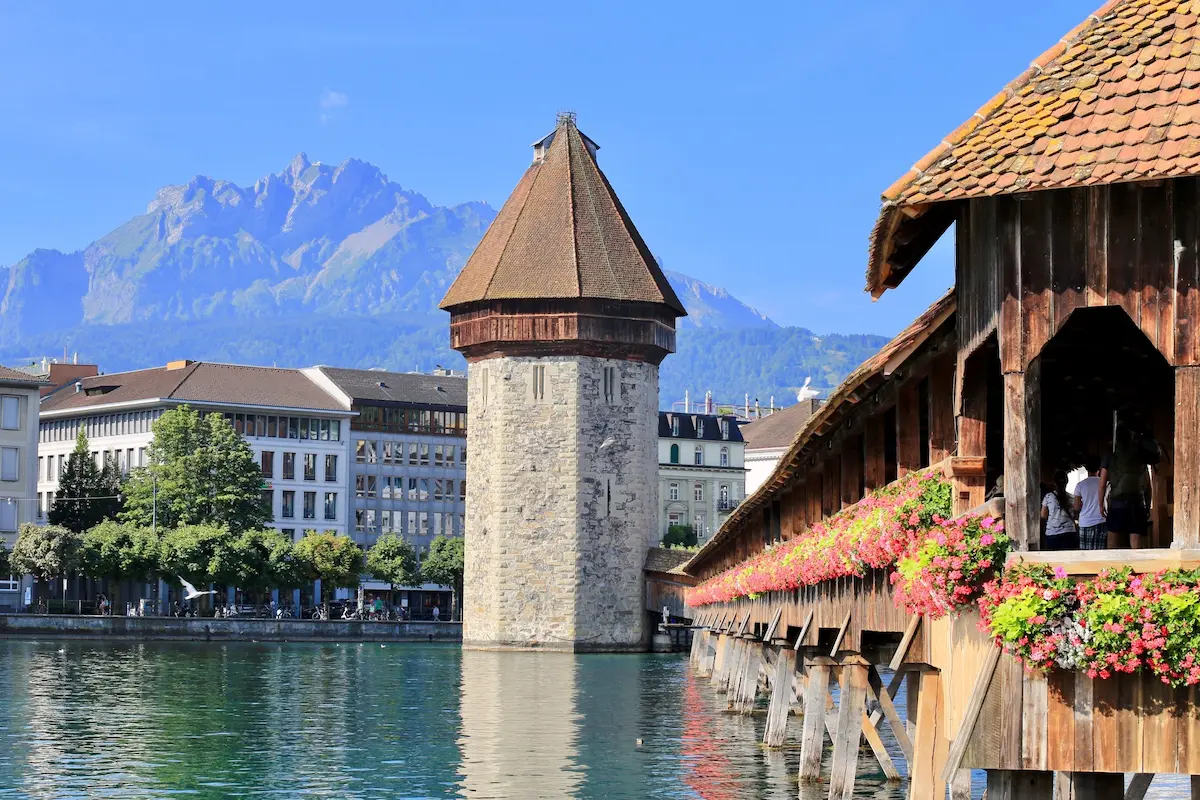
Start at the Kapellbrücke (Chapel Bridge) early, before the tour groups land. It’s a covered wooden footbridge dating to around 1360, and the triangular paintings tucked under its roofline go back to the 17th century. Cross it, then follow the Reuss river back toward the old quarter. You’re now in the Altstadt, where the medieval squares — Weinmarkt, Hirschenplatz, Kornmarkt — carry painted facades on nearly every side. Give this loop two to three hours if you like stopping for coffee and photos, or about ninety minutes if you move at a clip.
A few minutes upriver sits the Spreuer Bridge (Chaff Bridge), the second surviving covered bridge and usually far emptier than the Chapel Bridge. If the first one is shoulder-to-shoulder by mid-morning, this is where you get your quiet river shot.
Land here on a Tuesday or Saturday morning and the riverside farmers’ market runs along the Reuss through the morning — alpine cheeses, fresh bread, seasonal produce. It isn’t staged for visitors, which is exactly why it’s worth ten minutes of your walk. Market days and hours shift with the season, so check luzern.com before you plan around it.
The Lion, the Wall, and a maze of mirrors
North of the river, three sights cluster close together and make a natural second block of the day.
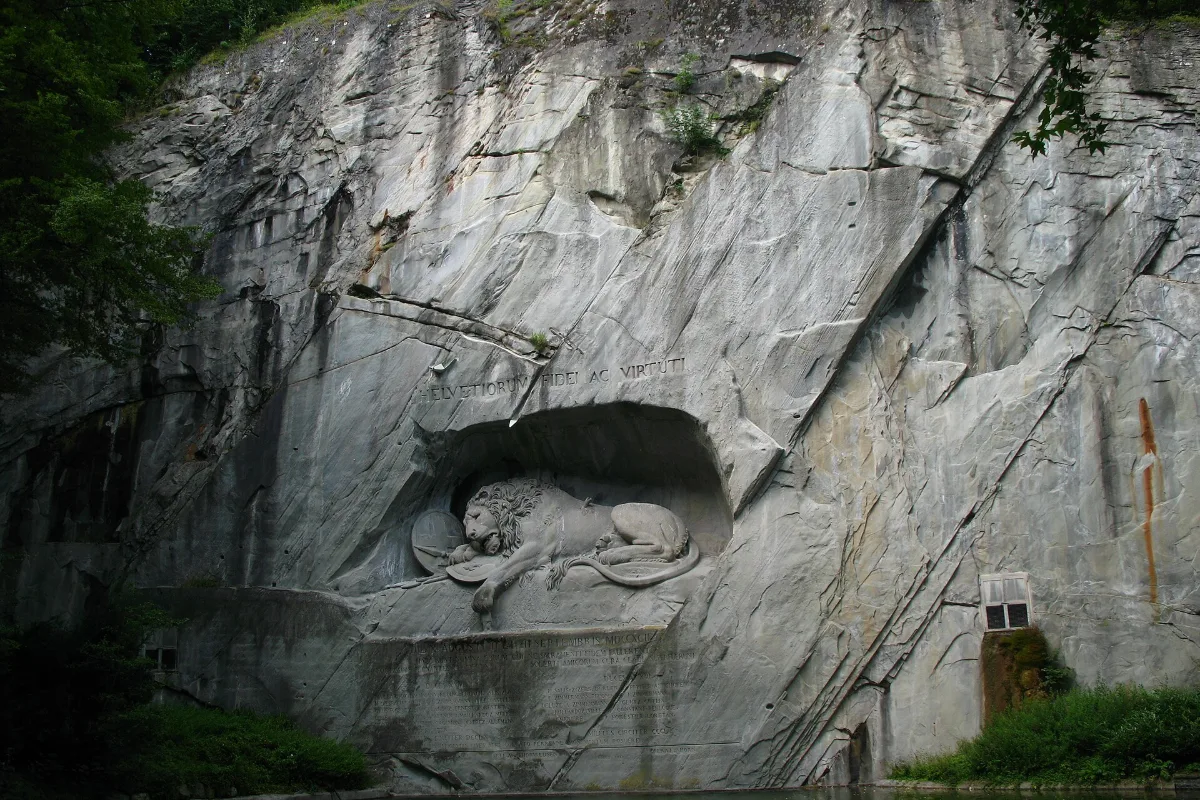
The Löwendenkmal (Lion Monument) is a dying lion carved straight into a rock face — a memorial to the Swiss Guards killed in 1792. It takes five minutes to see and it gets crowded, so aim for early or late rather than midday. Right beside it, the Glacier Garden (Gletschergarten) hides a genuinely odd bonus: a mirror maze of 51 mirrors built in 1896 for a national exhibition and moved here in 1899. It’s the kind of small, strange stop that breaks up an afternoon of medieval architecture.
Then climb the Museggmauer (Musegg Wall). This 13th-century rampart is one of the best-preserved city walls in Switzerland, and several of its towers are open to walk up — for free — with views straight down over the tiled roofs and out to the lake. It sits a level above the main shopping streets, which is why it’s easy to walk straight past. For a free viewpoint over the tiled roofs and the lake, there’s nothing else this central.
If you still have energy, the short funicular up to the Château Gütsch hotel terrace gives you the postcard angle over the rooftops. It’s a ninety-second ride and free with the Lucerne Visitor Card (more on that below).
If it rains, move indoors — and don’t waste the swap
Lucerne’s rainy-day answer is the Swiss Museum of Transport (Verkehrshaus), reported as Switzerland’s most-visited museum (Last verified: July 2026, Verkehrshaus). Treat it as a genuine half-day: aircraft, locomotives, historic cars, hands-on exhibits, plus a planetarium and a chocolate experience under one roof. It sits a short bus or boat ride along the lake’s north shore, a few minutes from the centre. For a full route that sequences indoor clusters, live visibility checks, and conditional boat or mountain options, see things to do in Lucerne when it rains.
Here’s where a two-day plan earns its keep. If day one turns wet, do the museum on day one and hold the Old Town walk for a drier window. The bridges and squares don’t need good weather to work — they just look flat under grey — so they’re the flexible part of your two days. Anything indoors is your rain insurance; spend it on the day the sky lets you down.
Day Two: Pick Your Mountain — Pilatus or Rigi
So, which summit? The honest answer turns on three things: the season, how much of the day you want to spend traveling, and whether you’d rather stand on a dramatic rocky ridge or wander a wide green plateau.
For a detailed comparison of fares, pass coverage, routes, and operating windows, see Mount Pilatus vs Mount Rigi.
Both mountains are day trips built from the same ingredients — a boat across Lake Lucerne, a cogwheel train, a cable car or two. But they behave differently, and one of them may not be fully open when you visit.
| Mount Pilatus (Golden Round Trip) | Mount Rigi | |
|---|---|---|
| Season (2026) | Seasonal — full boat loop 11 May–18 Oct; cogwheel runs to 29 Nov | Year-round |
| Summit height | 2,132 m (Pilatus Kulm) | 1,798 m (Rigi Kulm) |
| The route | Boat → steepest cogwheel (48% grade) → cableway → gondola → bus | Boat → cogwheel (Europe’s first, 1871); ride up one side, down another |
| Time to allow | ~5 hours minimum | ~5–7 hours, flexible |
| Cost (2026, ballpark) | Full round trip roughly CHF 120, 2nd class — check the official site | Day pass CHF 84 from 1 June 2026 — check current terms |
| Character | Rocky, dramatic; busier summit | Broad green plateau; easy strolling |
| Rail passes | 50% off mountain legs with Swiss Travel Pass | Trains and cableways free with Swiss Travel Pass or Lucerne Travel Pass |
| Best for | Warm-season visitors who want the showpiece loop | Any date; a calmer, walkable summit |
Last verified: July 2026 — sources: Pilatus-Bahnen, Rigi Bahnen, SGV Lake Lucerne. Mountain fares and operating dates change every season; confirm the day’s price and timetable on the official site before booking.
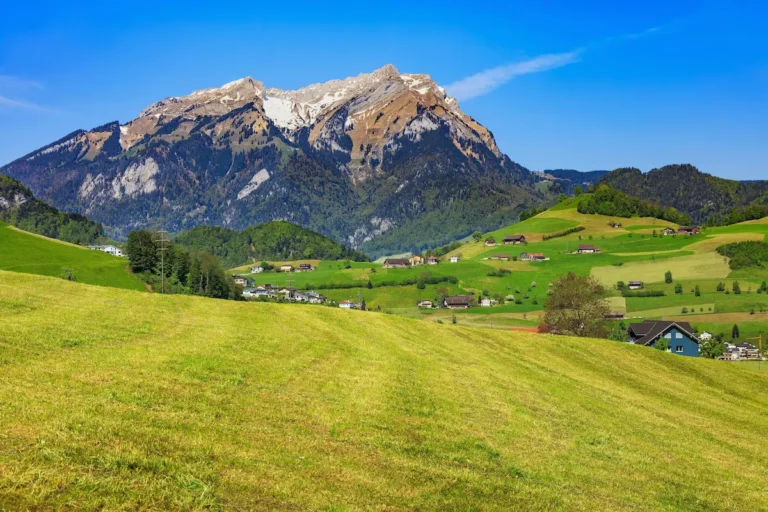
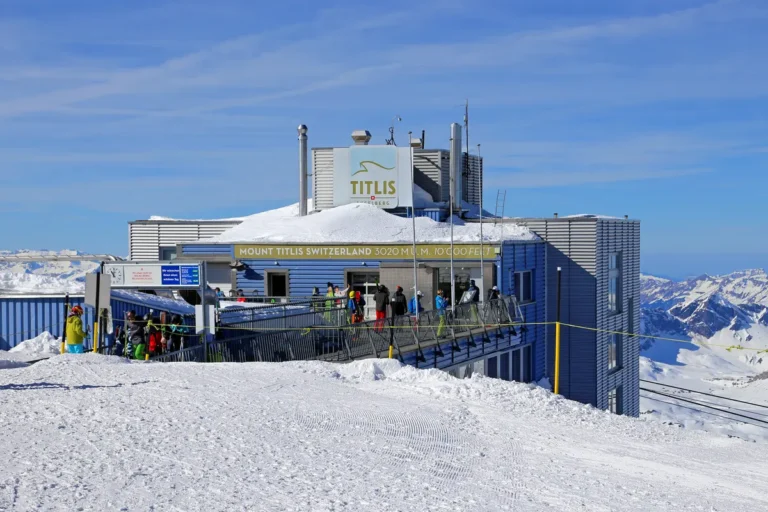
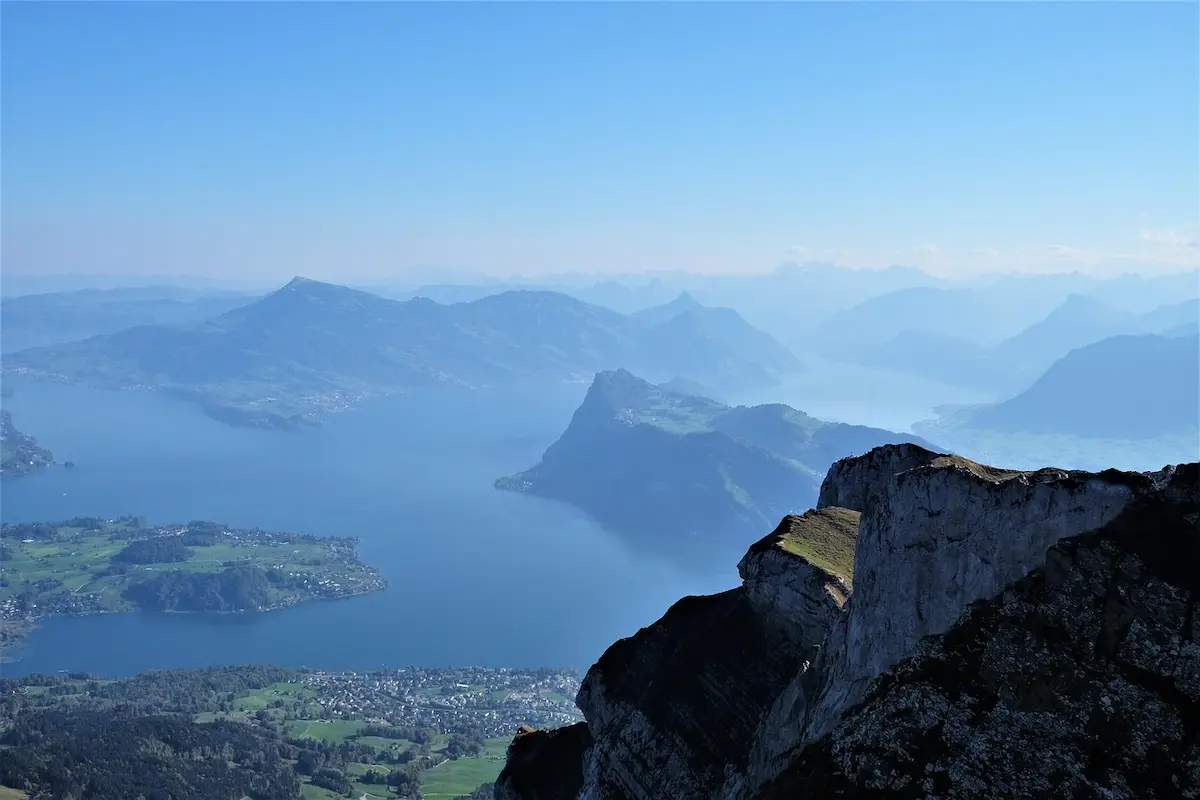
Mount Pilatus is the showpiece. The classic Golden Round Trip runs one direction around the mountain: boat from Lucerne to Alpnachstad, up the world’s steepest cogwheel railway — a 48% gradient — to Pilatus Kulm at 2,132 m, then down the far side by the “Dragon Ride” aerial cableway to Fräkmüntegg, a panorama gondola to Kriens, and a bus back into town. Allow at least five hours, more if you want lunch at the top.
The catch is the calendar: the cogwheel railway runs roughly 11 May to 29 November 2026, but the boat leg that turns it into a loop stops around 18 October 2026 (Last verified: July 2026, Pilatus-Bahnen). Outside those dates you can still reach the summit from Kriens by cable car — it runs year-round apart from short maintenance breaks — but it’s an out-and-back, not the full circuit.
You can also run the loop in reverse (bus and gondola up from Kriens, cogwheel and boat down), and there’s a good reason to: going up early means you clear the summit before the midday cloud and the biggest crowds arrive.
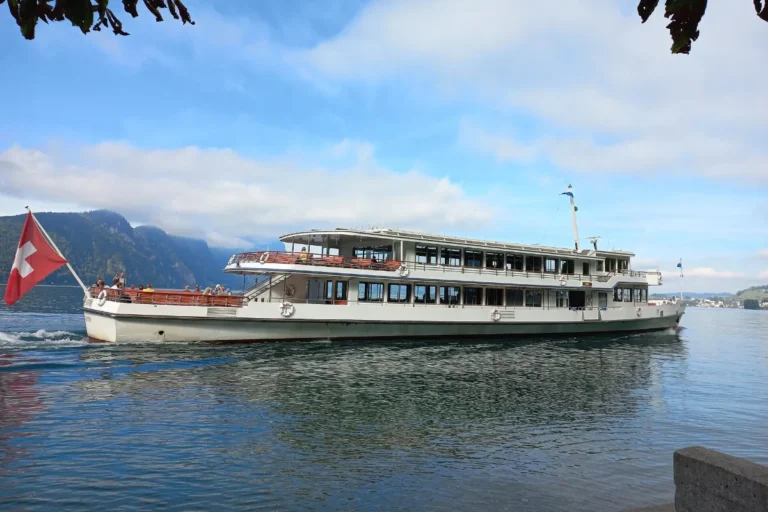
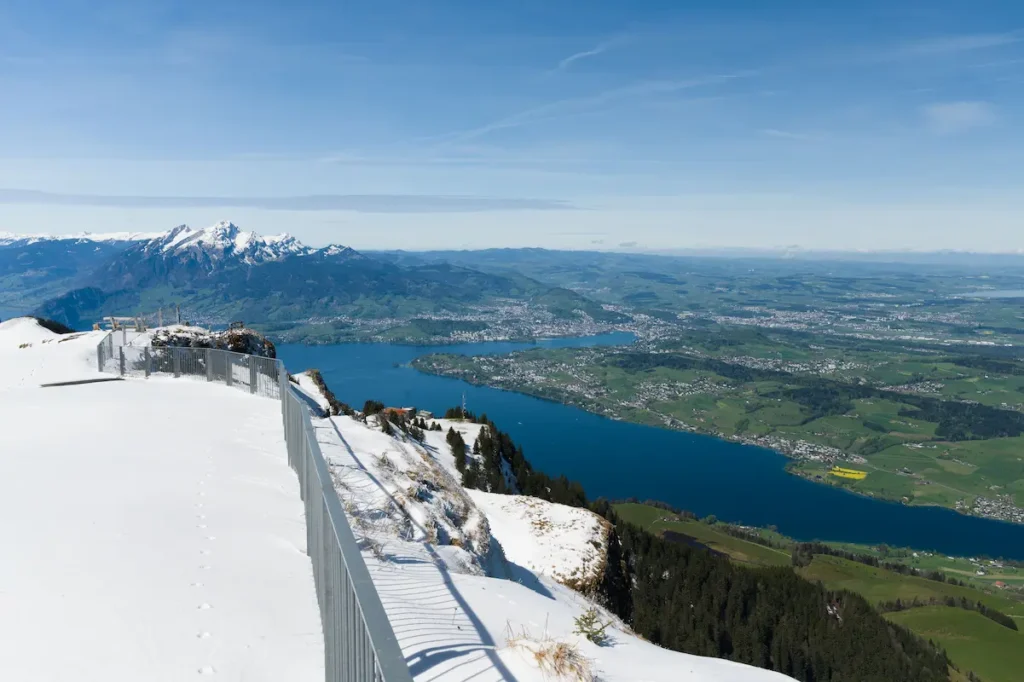
Mount Rigi is the all-season pick. The cogwheel railway from Vitznau — Europe’s first mountain railway, opened in 1871 — climbs to Rigi Kulm at 1,798 m in about 30 minutes, and the whole network runs year-round (Last verified: July 2026, Rigi Bahnen). Rigi’s summit is a broad, gentle plateau with 360-degree views, far better for casual walking than Pilatus’s rocky crest. You reach Vitznau by boat from Pier 1 in Lucerne in roughly 45 to 60 minutes, which makes the lake crossing part of the day rather than dead transfer time. Come down a different way — the cable car to Weggis, then a boat back — and you’ve circled the mountain without retracing a step.
On cost, both sit in a similar range, and rail passes cover them to different degrees, which is the detail that decides whether you buy a full-fare ticket at all. Because those fares shift each season, treat every figure here as a ballpark and confirm the day’s price on the official site before you commit.
Which one, then?
If you’re visiting between late May and mid-October and you want the single most scenic loop, take Pilatus. If you’re here in winter or the shoulder season — or you simply want a calmer summit with room to stroll — take Rigi. It’s open when Pilatus’s full loop isn’t, and the plateau suits a relaxed half-day better than the scrum on Pilatus Kulm.
When to Flip the Two Days
The order isn’t fixed, and getting it right is the most useful move in this whole plan.
The rule is simple: the mountain day should fall on the clearer day. A summit buried in cloud is money and hours spent staring at grey, while the Old Town loses almost nothing to an overcast sky. Check the forecast a day or two out, put the mountain on whichever day looks brightest, and take the city on the other.
What if both days look mixed? Use the live mountain forecast and webcams, choose the clearer half of the better day, and keep the city for the flexible slot, since bridges and museums do not depend on summit visibility. Summer can still bring showers and thunderstorms, so do not treat the season alone as a guarantee; recheck conditions shortly before departure and take the mountain first only when the forecast supports it.
Getting There, Boats, and Which Pass Actually Pays Off
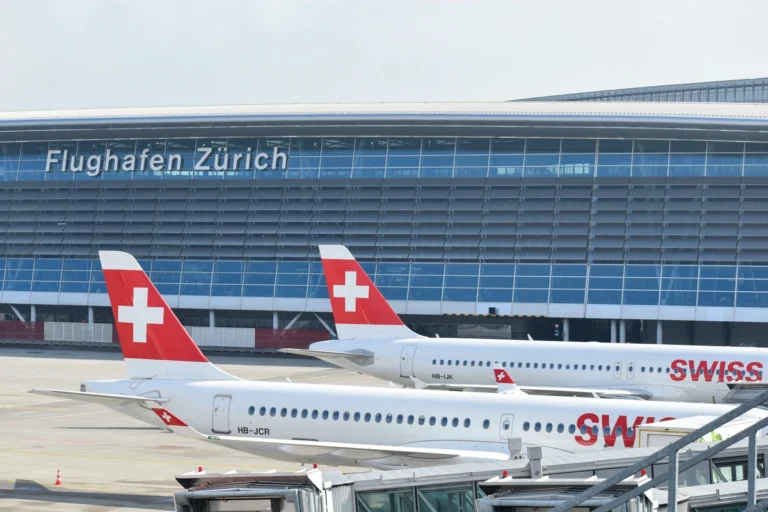
You don’t need a car for any of this. Lucerne’s train station, the boat piers and the mountain bus stops all cluster at the head of the lake, a few minutes apart on foot. If Lucerne is your first stop after flying in, the Zurich Airport to Lucerne comparison explains when that station-centered setup makes the train the simple choice — and when a door-to-door car solves more.
Where you sleep changes this math more than most people expect — here’s where to stay in Lucerne, area by area.
Boats for both mountains leave from the piers directly in front of the station — Rigi departures (via Vitznau) from Pier 1, and the Pilatus loop via Alpnachstad from the same waterfront (Last verified: July 2026, SGV Lake Lucerne). Buses to Kriens for the Pilatus cable car also leave from beside the station. The boat and cogwheel timetables are coordinated, so you won’t be left stranded between legs — but they do thin out in the shoulder season, which is one more reason to check the day’s schedule before you set off.
The pass question — don’t overbuy for two days
This is where two-day visitors quietly waste money. A few options, from most to least useful for a 48-hour stay:
- Lucerne Visitor Card: issued to eligible overnight guests through their accommodation. The official terms include free second-class buses and trains within zone 10 and selected discounts; boat cruises are excluded. Confirm the validity dates and the correct proof for your first arrival before buying another city ticket.
- Swiss Travel Pass: covers boats, buses and trains nationwide, knocks 50% off the Pilatus mountain segments, and covers Rigi’s trains and cableways in full. It earns its price when Lucerne is one stop on a wider Swiss trip — less so if it’s your only base.
- Regional passes (such as the Tell Pass): cover most transport and mountains around Lake Lucerne, but they’re priced for heavy, multi-day use. For two days built around a single mountain, the math usually doesn’t work — you’d need to be riding all day, both days, to break even.
The practical rule for two days: take the free Visitor Card, and only buy a Swiss Travel Pass or regional pass if you’re traveling beyond Lucerne or planning to ride hard on both days. Otherwise, pay per segment for the one mountain you choose. Pass prices and coverage shift year to year, so confirm the current terms on the official site before committing.
FAQ
Is two days enough for Lucerne?
Yes — for the highlights plus one mountain. Two days comfortably covers the Old Town, the Lion Monument and the Musegg Wall on foot, then a full day trip to Pilatus or Rigi. It isn’t enough for both mountains, several museums and a lake tour, so pick one summit and don’t overpack the city day.
Pilatus or Rigi — which is better?
Pilatus for the more dramatic loop and the world’s steepest cogwheel railway, but its full round trip is seasonal — roughly May to mid-October in 2026. Rigi for year-round access and a gentler, walkable summit. In winter or the shoulder season, Rigi is often the only one of the two whose full circuit is still running.
Is the Swiss Travel Pass worth it for two days?
Mainly if Lucerne is part of a bigger Swiss itinerary. For two days in Lucerne alone, the free Lucerne Visitor Card plus per-segment mountain tickets usually works out cheaper. Check current prices on the official site, since pass rates change each year.
Can you do Lucerne without a car?
Easily. The station, boat piers and mountain bus stops all sit within a few minutes of each other, and every route in this plan — city, Pilatus and Rigi — runs on public boats, trains and buses.
Which Two-Day Plan Fits Your Trip
Strip a Lucerne 2 day itinerary back and the choice is simple. Day one is fixed: the Old Town on foot when the sky allows, with the Transport Museum as your wet-day swap. Day two is where you actually decide — Pilatus if you’re here in the warmer half of the year and want the full loop, Rigi if you want a summit that’s open whatever the date and calm enough to wander.
So pull up the forecast the night before and put the mountain on the brighter day. Then book your cogwheel or boat slot for the morning, before the Alpine cloud has a chance to close in on the view you came all this way to see.